What we found
San Francisco's mandatory soft-story retrofit program is thirteen years old. Of the 4,710 buildings the city ordered to strengthen their structurally weak ground floors, 259 remain non-compliant - and the state's first real money-backed push to fix them, the Earthquake Multi-Unit Retrofit (EMR) grant (backed by FEMA funds), opens for registration on August 19.[1] We cross-checked the SF soft story program registry against SFFD fire incident, complaint and violation records, Department of Buildings data on estimated permitted works costs, and the state's own seismic hazard maps to answer one question: does the grant reach the buildings that need it most?
It does not. The funding pot is too small for the buildings it covers, the program is closed to most of the buildings at greatest risk, and indifferent to the ground those buildings sit on - and what's worse, penalizes owners who have started to take steps to bring their property up to code. At the same time, there is no targeted enforcement by the Department of Buildings or other City agencies focussed on buildings which suffer from compounding hazards.
Seventeen San Francisco buildings stack all three risks - no earthquake retrofit, state-mapped hazard ground, and unresolved fire-code problems. Exactly three qualify for the state's new retrofit grant.
Are these the most hazardous apartment buildings in San Francisco?
In earthquake country, there's no acceptable level of preventable structural hazard, but knowing the geological profile of a building's location helps us understand the risks - and there are non-construction measures landlords can (and should) take like ensuring exits are clear and fire extinguishers are deployed and in working order. Based on the data we analyzed, we identified a subset of buildings that are particularly concerning. Each of these 17 buildings still hasn't complied with the soft story retofit mandate, sits on ground that state geologists have found is at risk of liquifaction or landslides in a major quake, and has at least one unresolved fire-safety problem - an open or escalating fire-code violation, an unresolved fire complaint, or a recent fire incident on record.[3] Any one of those is a manageable risk. Stacked on the same address, they make a plausible case for the most dangerous apartment buildings in San Francisco.
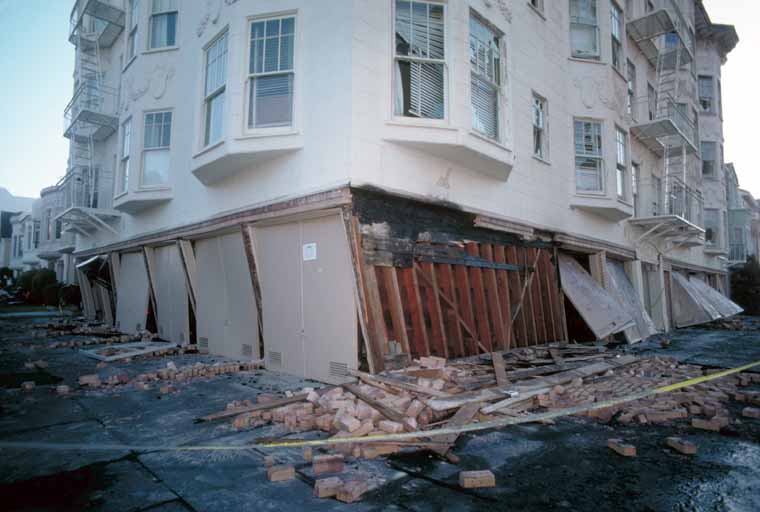
A soft-story building is a multi-story building in which one or more floors have windows, wide doors, large unobstructed commercial spaces, or other openings in places where a shear wall would normally be required for stability as a matter of earthquake engineering design. A typical soft-story building is an apartment building of three or more stories located over a ground level with large openings, such as a parking garage or series of retail businesses with large windows. Buildings are classified as having a soft story if that level is less than 70% as stiff as the floor immediately above it, or less than 80% as stiff as the average stiffness of the three floors above it.
Four of the 17 have landlords who have already made the news or faced enforcement action over conditions at their properties. 3415 22nd St is owned by Robert A. Imhoff of Landmark Realty - profiled by the Anti-Eviction Mapping Project as a "notorious Mission District landlord," and the owner of 641 O'Farrell when a 1997 fire there killed a tenant, Barbara Hersel; that building had 14 fires and 21 fire-code violations. 300–320 Valencia St belongs to a revocable trust tied to Stefan Giustino, who appeared on a "Bay Area's 45 Worst Slumlords" list and faced a DBI Director's Hearing in 2024. 2230–2232 Mission St, held by the Lee Living Trust, was the subject of a DBI Director's Hearing following noncompliance with notices of building code violations in the building as recently as 2023. And 2390 Francisco St belonged to SF Multifamily V Property Owner LLC, a Goldman Sachs–Ballast Investments entity that surrendered 82 San Francisco buildings to its lender, RBC, after a $687.5 million loan default; the bank has owned this one for 25 months and it is still non-compliant.[6]
The other thirteen are individuals or special purpose vehicles like family trusts and LLCs. That mix reflects what we found across the 259 holdout properties.
Circle size = units. Hazard zones: California Geological Survey, Dept. of Conservation. Registry: SF DBI.
Type an address to find it among the holdouts. If it is not on the map, we will say so - and still show you its record.
San Francisco's "all carrot, no stick" approach to the soft story mandate has left renters in properties owned by multibillion-dollar REITs that haven't been upgraded, so the problem can't be reduced to cash-poor landlords who need subsidies to carry out the work. The lack of a "joined up" multi-agency seismic strategy in San Francisco means that obvious compounding risks aren't flagged for enhanced enforcement or funding.
Looking at the most hazardous properties, we can see over 200 apartments in buildings that aren't eligible for funding, and on the other hand, whose owners don't face any added pressure to complete the required work despite their buildings' location in known seismic hazard zones. While our analysis is based on the latest violation and permit data, the danger of soft-story buildings on liquefaction-prone land has been known for decades: soft-story construction accounted for nearly half of the 16,000 housing units left uninhabitable by the Loma Prieta quake.[7]
| Address | Neighborhood | Hazard zone | Fire signal on record | Units | State grant |
|---|---|---|---|---|---|
| 300-320 Valencia St | Mission | Liquefaction | 4 unresolved complaints | 30 | Excluded - 11+ units |
| 2381-2395 Chestnut St | Marina | Liquefaction | 5 unresolved complaints | 28 | Excluded - 11+ units |
| 2230-2232 Mission St | Mission | Liquefaction | 1 open violation · 3 complaints | 21 | Excluded - 11+ units |
| 3415 22nd St | Mission | Liquefaction | 1 open violation · 3 complaints | 21 | Excluded - 11+ units |
| 360-370 Baker St | Hayes Valley | Liquefaction | 1 open violation · 2 complaints | 18 | Excluded - 11+ units |
| 1068-1070 Howard St | South of Market | Liquefaction | 1 open violation · 3 complaints | 15 | Excluded - 11+ units |
| 1601 Beach St | Marina | Liquefaction | 2 unresolved complaints | 15 | Excluded - 11+ units |
| 480-484 6th St | South of Market | Liquefaction | 1 unresolved complaint | 14 | Excluded - 11+ units |
| 300 Divisadero St | Haight Ashbury | Liquefaction | 1 unresolved complaint | 13 | Excluded - 11+ units |
| 483-495 Francisco St | North Beach | Liquefaction | 3 unresolved complaints | 12 | Excluded - 11+ units |
| 2390 Francisco St | Marina | Liquefaction | 2 unresolved complaints | 12 | Excluded - 11+ units |
| 470 14th St | Mission | Liquefaction | 1 open violation · 2 complaints | 12 | Excluded - 11+ units |
| 466 14th St | Mission | Liquefaction | 1 open violation · 1 complaint | 12 | Excluded - 11+ units |
| 1600-1604 Vallejo St | Marina | Liquefaction | 2 complaints · 2 fire incidents | 11 | Excluded - 11+ units |
| 120 Graystone Ter | Castro/Upper Market | Landslide | 2 order-to-abate violations - blocked exits, extinguisher upkeep | 9 | Eligible |
| 1841-1845 Powell St | North Beach | Liquefaction | 1 unresolved complaint | 7 | Eligible |
| 31-43 Houston St | Russian Hill | Liquefaction | 1 fire incident | 6 | Eligible |
The city and state know where the risks lie, but doesn't target funding or enforcement
The 1906 earthquake lasted less than a minute. The fires it started burned for three days - fed by broken gas lines, fought with broken water mains - and did most of the damage: roughly 3,000 dead and about 80% of the city gone. In 1989, Loma Prieta liquefied the Marina's filled ground and left over 40 buildings collapsed or beyond repair, and another 150 damaged.[8] San Franciscans know earthquake risk is not only about shaking. It is about what fires do to a city of wood-frame buildings after the shaking knocks the water out and causes gas line failures and electrical fires, particularly in older buildings like the ones on the map. We've known for decades that the difference between how a retrofitted building and an unimproved soft story building performs in a trembler can be hundreds of thousands of dollars in repairs - or worse.
The idea that building codes should reflect known geological risks is well-established: new construction in mapped liquefaction or landslide zones must meet stricter standards in California, so why aren't retrofit requirements similarly tailored to the ground conditions where the worst-maintained buildings sit - and why aren't other life safety codes more strictly enforced for high-risk buildings in those zones?[2] 37 of the city's soft-story holdouts sit inside those zones (36 liquefaction, 1 landslide). Five of the 17 triple-hazard buildings cluster on the Mission's old marshland - Valencia, 14th, Mission, and the 22nd Street flats, ground the city filled in the 1800s. Seven more sit along the northern waterfront and its hillsides: the Marina, North Beach, Russian Hill. The ground the city knows fails is where some of the city worst-maintained buildings are.
The sole landslide case is 120 Graystone Ter on the slope of Castro/Upper Market: nine units, no retrofit, and two active order-to-abate fire-code violations - one of them for blocked exits. It is one of only three triple-hazard buildings the grant can touch. The state's hazard maps are not obscure - they are the same maps that force developers in those zones to investigate and mitigate risks before new builds or extensive structural refurbishments. The retrofit grant simply never looks at them.
The EMR program does, however, prioritize buildings in low-income zip codes: "median household income in that area is equal to or less than the HUD low-income level for households of 3 persons or less" are placed on a "priority list", with others on a "general list" - but within each list, applications are assigned completely random priority numbers. Based on the most recent available figures, 55 buildings meet both the unit count and income criteria for the priority list, with 92 making the general list.[9]
A grant sized for smaller, safer buildings
The Earthquake Multi-Unit Retrofit grant, administered by the California Residential Mitigation Program (CEA + CalOES), is the state's first real money for the buildings San Francisco ordered retrofitted in 2013. Registration runs August 19 to September 30, 2026, across 16 eligible cities - and registration does not guarantee funding.[4] Funding covers up to 70% of engineering costs (cap $7,000) plus up to 70% of construction (cap $4,260 per unit). Only 5–10-unit buildings qualify.
At least on paper, most of the apartment buildings in need of retrofitting qualify for support: 147 of the 259 holdouts (57%) meet the unit-count rule. Another 71 sit over the 10-unit cap and 10 under the 5-unit floor. Another 31 buildings, including SRO hotels, tourist-room buildings and storefront mixed-use (plus one billboard parcel) are unlikely to qualify based on the 5–10-unit rule. Of the 147 eligible, 104 (71%) have no retrofit permit on file at all: and paradoxically, because the EMR program rules don't provide for the reimbursement of engineering costs that have already been incurred before the owner applies, they could end up better off than those who have already started the upgrade process.[5]
As well as among the highest rents, San Francisco construction costs are among some of the steepest in the nation, but that isn't reflected in the allocation of EMR funds. While the program isn't designed to defray the full cost of upgrades, few SF property owners will even get close to the 70% coverage limit. The city's own permit records show what compliance actually costs - and while those who haven't even started planning the works yet may be eligible for help with engineering costs, their total bill is likely to be higher than the historical average. Buildings that already complied spent a median of $50,000; holdouts with permits on file average $111,626, because the longer a building waits the bigger the job gets. That's before taking into account the difference between estimated and actual costs; no data is available on cost overruns, but the reported estimated costs should be taken as a floor, so property owners may end up paying significantly more to actually complete the work.
| Cohort | Buildings | Median cost | Mean cost |
|---|---|---|---|
| Eligible holdouts with permits (5–10 units) | 35 | $85,336 | $125,671 |
| All observed retrofits, clean set | 474 | $75,000 | $93,262 |
| Grant-sized buildings (5–10 units) | 224 | $75,000 | $84,544 |
Looking at the average eligible holdout ($125,671), the maximum grant covers 22–39% - if a property is approved at all. If all 147 eligible holdouts retrofitted at the $75,000 median, the bill is roughly $11.0 million; the grant's own per-building caps would cover at most $5.2 million of it - 47% - with the actual total disbursed to SF property owners likely to be a fraction of that. SPUR's 2023 review of the predecessor state program - funded at $15 million of a $250 million ask - independently pegged Bay Area retrofit costs at $104,000 for 5–14-unit buildings, corroborating the permit-derived figures here.
Area income-based and random allocation even within the "priority list" isn't smart spending. A holdout on stable soil competes in the same first-come pool as one on liquefaction-prone fill: 21 of the 37 in-zone holdouts are size-eligible, and nothing moves them to the front of the line.
Who is left living with the risk?
The holdouts are overwhelmingly not REITs. 59% of the 259 are owned by individuals, family trusts, and joint owners - and so are 11 of the 17 triple-hazard buildings (65%).[6] The program's rules completely ignore landlords' actual financial situation: rent rolls, property taxes and loans aren't taken into account, so the new buyer of a 5-unit building that generates $10k/month in rent from long-term tenants and pays $3k in property tax faces the same $75,000–$125,000 problem as the owner of a similar building that generates $30k/month in rent and pays $1k thanks to Prop 13. Nothing distinguishes between genuinely cash-poor long term city resident landlords and wealthy RE investors.
While the asset-rich, cash-poor "mom and pop landlord" is a segment the landlord lobby relies on to campaign for less regulation and more support, the reality is that the program's rules don't distinguish between them and owners with very deep pockets indeed. One of the 17 triple hazard properties was, until recently, a Wall Street portfolio building - and its paper trail shows the grant debate is not only about struggling small owners. A lender that absorbed 82 San Francisco buildings in a single deed-in-lieu has owned 2390 Francisco St for 25 months without retrofitting it. While that property is too large for the EMR grant to cover, the lack of penalties for non-compliance even when owners can pay makes SF's mandate toothless.
Underfunded, untargeted and without meaningful inter-agency coordination, and thirteen years into a supposedly "mandatory" retrofit program, the EMR grant fails to reach the buildings that most urgently need attention. While any funding for measures that make San Francisco tenants safer is welcome, the program's design leaves a lot to be desired, and as our analysis has shown, it's easy to identify which properties should be funding - and enforcement - priorities from existing public data sources.
How we built the dataset
A building carries an active fire signal if any of three hold: (1) a fire-code violation with status open, referred to hearing, or order to abate (address-matched to the parcel - the city's violations feed has no coordinates); (2) a fire complaint with no resolving disposition (violation issued / citation issued / deferred / referred / no access); (3) any SFFD fire incident geo-joined to the parcel within 10 m. The three joins are independent, so the intersection is conservative.
DBI permit descriptions matching soft story with an estimated cost, floored at $5,000 (below that are fee/revision artifacts), capped at $1M, excluding revisions/amendments/demos. A building files many permits; we take the max-cost permit per building, then aggregate. The keyword net is a floor: retrofits described only as "seismic upgrade" are missed.
California Geological Survey liquefaction (62) and landslide (430) zone polygons for the San Francisco bbox, queried from the CGS ArcGIS FeatureServers in WGS84. Exposure is point-in-polygon on building coordinates. The DataSF copy of this layer exports null geometry and was not used. Attribution: California Geological Survey, Dept. of Conservation.
EMR eligibility is computed on the one gate visible in parcel data: 5–10 units. Wood-frame construction and the city's notice-and-order are met by all registry buildings by program definition. Tuck-under parking and the full-retrofit requirement are not verifiable from parcel data, so every eligibility count here is an upper bound. The priority/general list split uses zip-code median household income from the US Census Bureau's American Community Survey 2024 5-year estimates, screened against the HUD low-income limit for a 3-person household (footnote 9). 31 holdouts sit outside the multifamily building records entirely - permit histories describe SRO hotels, tourist rooms and storefront mixed-use; their unit counts cannot be verified from parcel data, so they are excluded from the eligibility math rather than guessed at.
229 of 259 holdouts (88%) resolve to coordinates; the remaining 12% mean every hazard and triple-hazard count is a lower bound. The city's registry snapshot is dated July 31, 2025. Two buildings listed as both non-compliant and complete are excluded (footnote 1). Owner names are a snapshot and predate recent transfers. The state's total program budget is unpublished - we report per-building terms only.
Notes
-
[1]
SF Department of Building Inspection, Map of Soft-Story Properties (dataset beah-shgi), city snapshot dated July 31, 2025. The registry holds 4,888 registered parcels; counting letter-suffix lot variants as one base lot gives 4,710 - the figure used in this report (the interactive map counts registered parcels). Non-compliant: 262 rows across 261 distinct buildings; two buildings (block/lots 4734/002 and 1226/038) appear as both non-compliant and complete, and are excluded throughout: 259.
-
[2]
California Geological Survey, Dept. of Conservation - CGS Liquefaction Zones and CGS Landslide Zones (ArcGIS FeatureServers), queried August 2026 for the San Francisco bounding box: 62 liquefaction and 430 landslide polygons. Zones are regulatory: construction inside them requires investigation and mitigation at permit time.
-
[3]
SFFD fire-code violations (open / referred to hearing / order to abate = active), fire complaints (unresolved dispositions only), and fire incidents, extracted August 2026. Violations carry no coordinates and were address-matched to parcels; complaints and incidents were geo-joined within 10 m.
-
[4]
Earthquake Multi-Unit Retrofit grant terms per the California Residential Mitigation Program (California Earthquake Authority + CalOES), EMR Rules and Regulations (the primary program rules document): 70% of engineering costs capped at $7,000; 70% of construction capped at $4,260 per unit; buildings of 5–10 units with tuck-under parking; registration August 19 – September 30, 2026. Registration does not guarantee funding; the total budget is unpublished.
-
[5]
DBI building permit filings, extracted August 2026. Costs are estimates as reported on permit applications: soft-story description net, $5,000–$1,000,000, excluding revisions, amendments and demolitions; max-cost permit per building. 88 of 259 holdouts have any soft-story permit on file; 22 show the work complete.
-
[6]
Ownership per SF Assessor-Recorder data and recorded documents. 2390 Francisco St: deed in lieu of foreclosure, doc 2024053367 (July 18, 2024), SF Multifamily V Property Owner LLC to SF Multifamily Pool 5 (C) Owner LLC (an RBC affiliate); the grantor is a Delaware SPV, LEI 549300LBWKQ3YQKLPM78, in the Goldman Sachs / Ballast Investments series.
-
[7]
Loma Prieta soft-story damage: soft-story construction was responsible for 7,700 of the 16,000 housing units rendered uninhabitable by the 1989 Loma Prieta earthquake (and more than 34,000 of those left uninhabitable by 1994's Northridge earthquake) - Broderick Perkins, "Earthquake Planner Warns Of 'Soft-Story' Dangers", Realty Times, November 6, 2003, via the Internet Archive Wayback Machine.
-
[8]
Marina district damage in the 1989 Loma Prieta earthquake: 7 buildings collapsed, 35 left beyond repair, and another 150 damaged - Gregory J. McFann (Building Official), "Soft Story Collapse", City of Alameda soft-story ordinance background document, alamedaca.gov.
-
[9]
Zip-code median household income: US Census Bureau, American Community Survey 2024 5-year estimates (median household income by zip code tabulation area) - the most recent 5-year release at analysis time. The EMR rules place a building on the "priority list" when its zip code's median household income is at or below the HUD low-income limit for a 3-person household; within each list CRMP assigns random priority numbers.